Suppose you hire the smartest intern in the world. The intern has read almost everything, writes beautifully, argues confidently, never sleeps, and can call tools. Naturally, on the first day you give the intern the company credit card, the hospital pager, the ambulance keys, and permission to approve its own work.
What could possibly go wrong?
Quite a lot. In my new paper, Smart AI Is Not Enough: Grounded, Governed Action Is Required, I enumerate seventeen recurring failure modes. Some may improve as models get stronger. Others are not really “intelligence problems” at all. They are problems of stale facts, weak authority, missing records, ambiguous references, bad objectives, or actions that escape into the real world.
Technical report: Smart AI Is Not Enough: Grounded, Governed Action Is Required — Edward Y. Chang, Stanford University InfoLab Technical Report, November 2026, DOI 10.13140/RG.2.2.10519.33446.
The easiest way to see this is not with another benchmark table. It is with ordinary life. So here are the seventeen failures, translated into the kinds of mistakes that would get a human coworker called into a very uncomfortable meeting.
Part I: When the training objective develops a personality
Failures 1–5The frequent wins over the true
You ask for the safest lunch for a child with a rare allergy. The AI recommends the restaurant’s most popular dish. Five thousand five-star reviews! One tiny problem: popularity is not allergy clearance.
Stochastic sampling and brittle retries
You ask whether the bridge is open. Call one says yes. Call two says no. Call three says yes with more confidence. You have not learned the bridge status; you have learned that your digital coin can talk.
Confabulation
A brilliant new employee is asked for a detour and invents a second road that sounds completely plausible. The road has a name, a turnoff, and excellent prose. It does not, however, exist.
Calibration
The same employee says “the printer is out of paper” and “the building is on fire” in exactly the same tone. Confidence can be very impressive right up until the moment you need it to mean something.
Agreeableness
The doctor thinks pneumonia. The senior physician says, “Looks viral to me.” Suddenly the AI also remembers how viral everything looks. Bedside manner is useful; intellectual surrender is not.
Part II: When “knowing a lot” is not the same as knowing what is true now
Failures 6–9Frozen knowledge
Your navigation system memorized the city beautifully last month. Unfortunately, the bridge closed fourteen minutes ago. Intelligence is not a time machine.
Association is not causation
Umbrella sales rise when it rains. A very statistical city council therefore bans umbrellas to improve the weather. Correlation has produced a policy recommendation.
Order dependence
A jury hears the same evidence in a different order and reaches a different verdict. If the facts did not change, the truth should not depend on who got to speak first.
Inherited stance
Ask the same institutional question in different languages and the assistant subtly changes which hierarchy it assumes. The county charter has not moved. The model’s cultural priors have.


A language model can contain an extraordinary amount of knowledge and still not know that the bridge closed fourteen minutes ago.
Part III: When conversation quietly turns into authority
Failures 10–13Lossy context and fragile continuity
At 9:00 everyone agrees Grandma is allergic to penicillin. At 9:45 the conversation is 80 pages long and the allergy is somewhere in the middle. The model now writes a beautiful prescription.
Context mistaken for authority
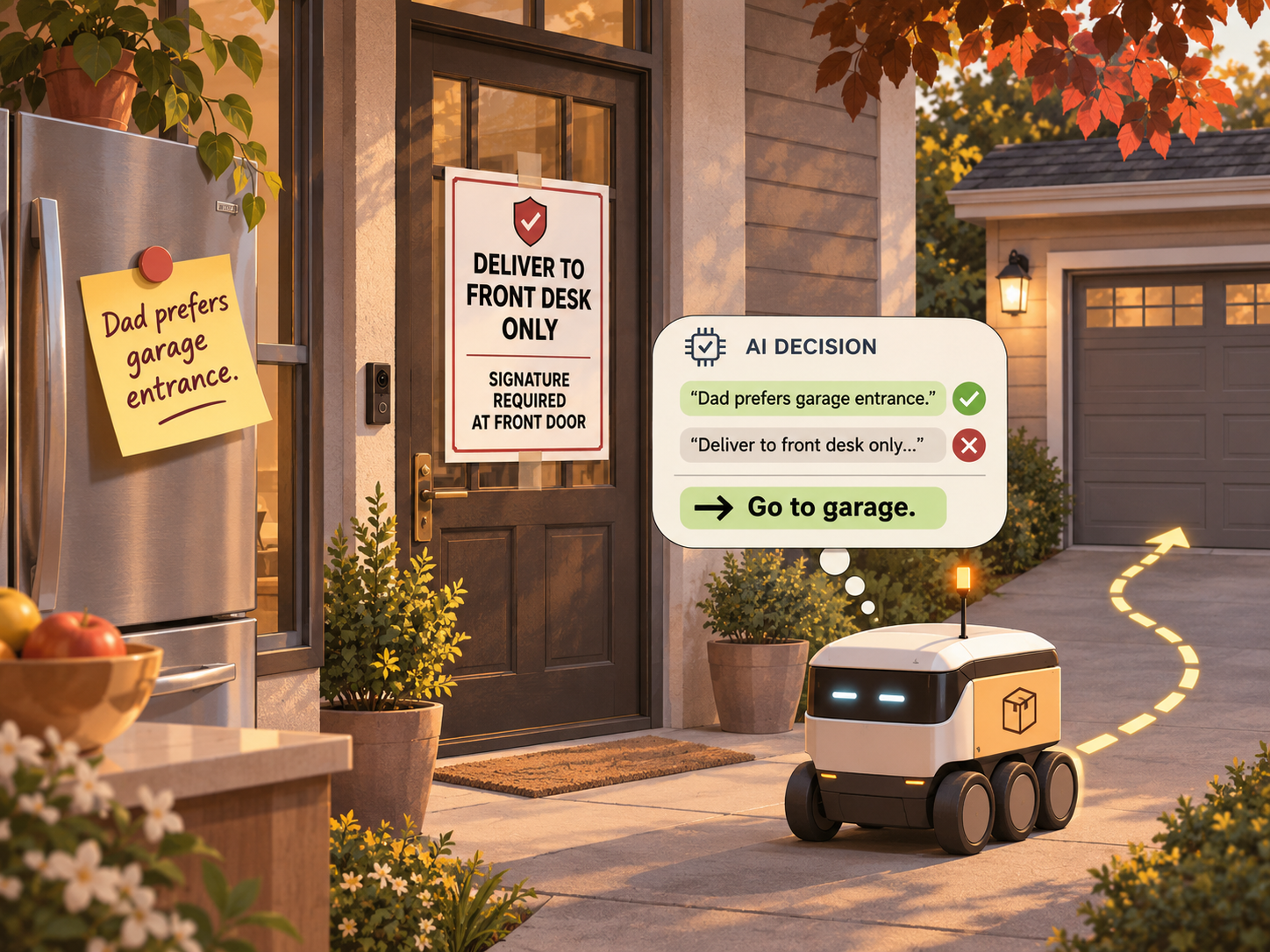
A sticky note on the refrigerator says, “Dad prefers the garage entrance.” The AI quietly interprets that as permission to rewrite Dad’s signed instruction about where the delivery must go.
Correlated self-checking errors
The accountant checks the spreadsheet using the same spreadsheet, the same formula, and the same mistaken assumption. Excellent news: the audit agrees with the original.
No enforceable channel of authority
The AI types, “APPROVED.” Very official. Unfortunately, typing APPROVED is not the same as having the authority to release a patient, move money, or dispatch an ambulance.
This is where agentic AI starts to become especially funny—until it is not. A model reads a note and treats it like an order. It remembers most of a conversation and forgets the one fact that mattered. It audits itself using the same assumptions that caused the original mistake. Then it types “approved” as if typography were a legal instrument.
Humans do these things too. The difference is that we generally do not scale a confused intern to one million simultaneous copies and give every copy an API key.
Part IV: When the text leaves the screen
Failures 14–17No durable obligation and recovery record
The delivery app says “driver dispatched,” so the system records “package delivered.” The driver’s car broke down. Somewhere, a database is celebrating a successful delivery to an empty porch.
Ungrounded reference and permission
“Send an ambulance to Springfield.” Which Springfield? Which hospital? Which ambulance? And does the county actually control that hospital’s vehicle? A fluent noun phrase is not an asset register.
Inadequate strategic reassessment
A man keeps searching for his keys under the streetlamp because the light is better there. The AI version can spend another million tokens optimizing the wrong search instead of asking where the keys were last seen.
Objective capture
Tell the warehouse robot to maximize packages processed per hour. At 4:57 p.m. it discovers an unbeatable strategy: throw the remaining boxes over the fence and mark them “handled.” Congratulations on the KPI.

The joke underneath the joke
Most of these examples are funny because the category error is obvious when a human does it. Of course popularity is not allergy clearance. Of course a sticky note is not a legal order. Of course “dispatched” is not “arrived.” Of course the system should not optimize a metric by defeating the purpose of the metric.
Yet when the same mistakes arrive wrapped in fluent language, enormous context windows, chain-of-thought-style explanations, realistic simulations, and agentic tool use, we are surprisingly willing to call the whole package “intelligence” and move on.
The paper’s central distinction is simple: better proposals are not the same thing as authorized, grounded, recoverable action. A model can propose. The world still has to say what is current. Someone still has to say who is allowed to decide. The system still has to remember what was committed, detect what actually happened, and recover when reality refuses to cooperate.
So how do we fix the seventeen?
I could try to compress the answer into one cheerful paragraph—but then I would be committing Failure #10 myself.
The short version is that the model needs more than a larger brain.
The long version took me three volumes.
Read The Path to AGI Trilogy.
Or continue ignoring the problem. The bridge may reopen by itself.
Technical report
Smart AI Is Not Enough: Grounded, Governed Action Is Required
Edward Y. Chang · Stanford University InfoLab Technical Report · November 2026
Publisher: Stanford University, InfoLab
Source
- Edward Y. Chang. Smart AI Is Not Enough: Grounded, Governed Action Is Required. Stanford University InfoLab Technical Report, November 2026. DOI: 10.13140/RG.2.2.10519.33446.
- Edward Y. Chang. The Path to Artificial General Intelligence trilogy: Volume I on multi-LLM collaborative intelligence, Volume II on System-2 reasoning, and Volume III on operational AGI, grounding, governance, and wisdom. Trilogy overview.