On October 6, OpenAI released 722 mathematical manuscripts, organized into 372 related result families, produced by an internal frontier model. Many came with machine-checkable Lean proofs. The release did not feel to me like another model update. It felt like a preview of a different research economy.
The immediate reaction is understandable: if a machine can generate hundreds of mathematical results at once, what happens to mathematicians, PhD students, professors, and the long apprenticeship through which researchers learn to think?
That distinction matters. A mathematical manuscript is not the same thing as mathematical understanding. Even when a proof is formally valid, humans still have to determine what was actually proved, whether the formal statement matches the intended claim, which idea is genuinely new, how it relates to prior work, what it teaches us, and which new questions it opens.
OpenAI itself acknowledged this unfinished layer. In announcing the release, it said future versions should improve citations, exposition, presentation, and understanding. On October 15, it went further, announcing a $5 million contribution to a Simons Foundation initiative intended to help mathematicians examine, understand, and build on AI-generated results.
That is revealing. When machine generation accelerates, human absorption becomes part of the bottleneck.
722 manuscripts change the question
For most of modern science, high-quality intellectual output was scarce. We built universities, journals, conferences, tenure systems, and graduate education around that scarcity. A researcher spent months or years producing a result. The community had time to read, debate, reproduce, teach, and place it into a larger conceptual map.
What happens when production speed changes by orders of magnitude?
One response is fear: there will be less left for people to do. Another response is triumphalism: research has been automated. I think both are too simple.
Terence Tao has recently framed the transition more constructively. In his October 2026 discussion of a possible “Math 2.0,” he warned against reducing mathematics to automated solution production and emphasized sustaining mathematical understanding and the mathematical community. In a separate essay, he offered a deceptively simple response to frontier AI: solve harder problems.
Perhaps AI does not eliminate the frontier. Perhaps it moves the frontier faster.
This possibility deserves much more attention. If AI compresses the time required to reach today's research frontier, then human researchers may spend less time reproducing familiar moves and more time asking questions that were previously too expensive, too interdisciplinary, or too difficult to attack.
My own experience: what changed when AI joined the research loop
In February 2026, before the current wave of AI-generated mathematics, I began an intensive experiment of my own: I used multiple frontier LLMs to attack the Collatz conjecture, one of mathematics' most famous unsolved problems.
The project eventually grew to 630 formally tracked results, roughly 1,014 computational scripts, and 29 mathematical paradigms. The models performed algebraic manipulation, wrote verification code, drafted proofs, proposed local frameworks, found computational counterexamples, and explored directions at a scale that would have been difficult for me to reproduce manually. The public preprint is explicit about one point: it does not prove the Collatz conjecture. What it does provide is a detailed record of how human and machine reasoning interacted over a long, difficult research trajectory.
The most interesting lesson was not that the models were weak. Quite the opposite. Their local mathematical capability was remarkable.
But the collaboration also made another layer of research unusually visible: deciding which direction was worth pursuing, when an attractive route had become a dead end, when a claim was stronger than its proof, when two agents were talking past each other, and when the research program needed a different conceptual frame rather than another iteration of the current one. In this project, many of those decisions came from the human moderator. That is an observation from one long collaboration, not a universal claim about what future systems can or cannot do.
One episode captures this. An earlier version of the Collatz work contained a false “Gap Lemma.” The algebra inside the restricted case was correct, and multiple model-assisted reviews accepted it. The real error was a scope assumption: the proof silently generalized from one class of exits to all exits. The decisive question was not “is this algebra right?” but “does every case actually satisfy the premise?” A targeted check immediately found counterexamples.
This is only one long-horizon mathematical case. It does not establish a universal law about LLMs. But it changed how I think about AI-assisted science.
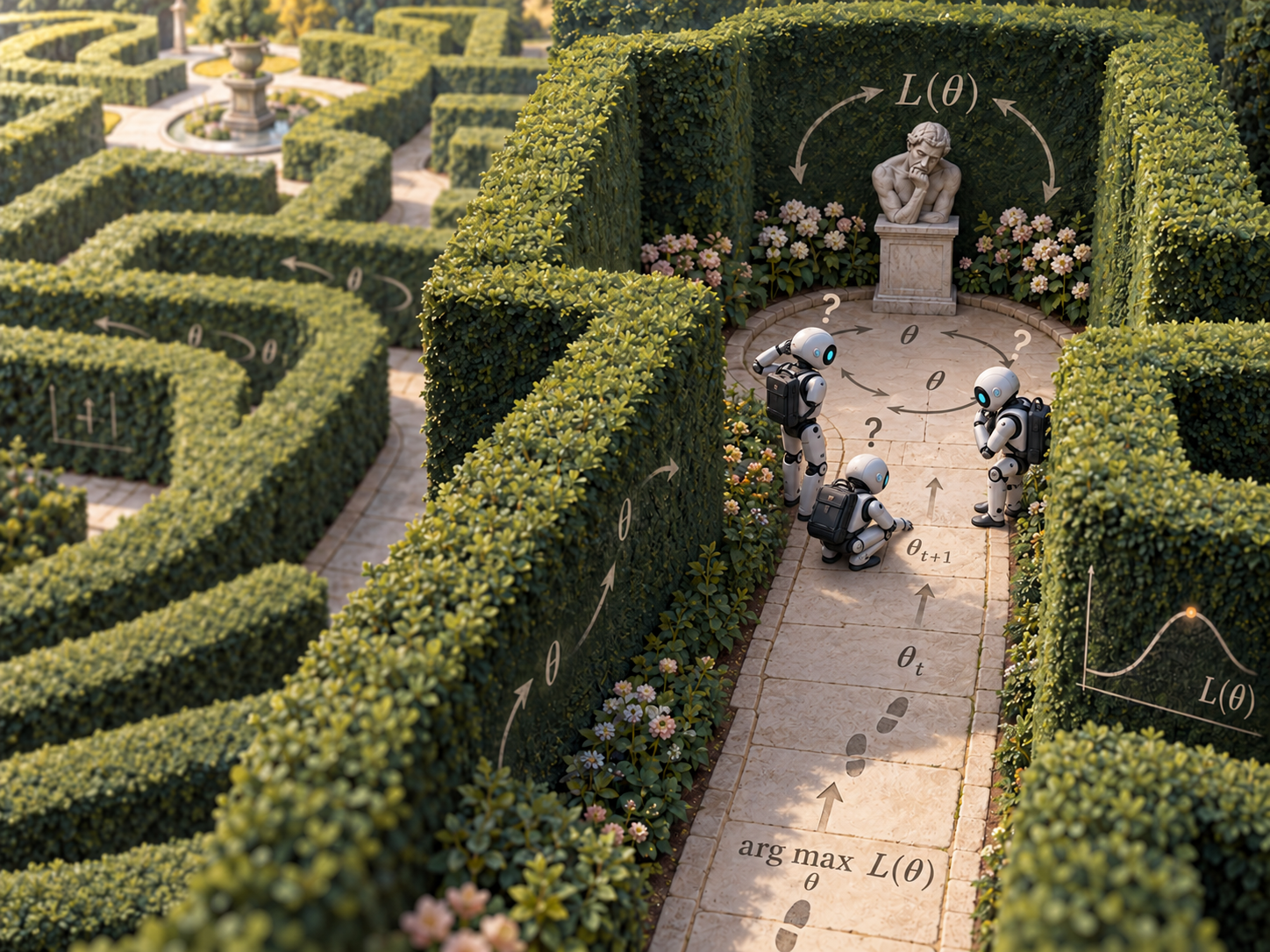
When more search does not change the search space
LLMs can be extraordinarily productive once a research direction is established. They can extend arguments, generate variants, test alternatives, and search a local neighborhood far faster than a human researcher working alone.
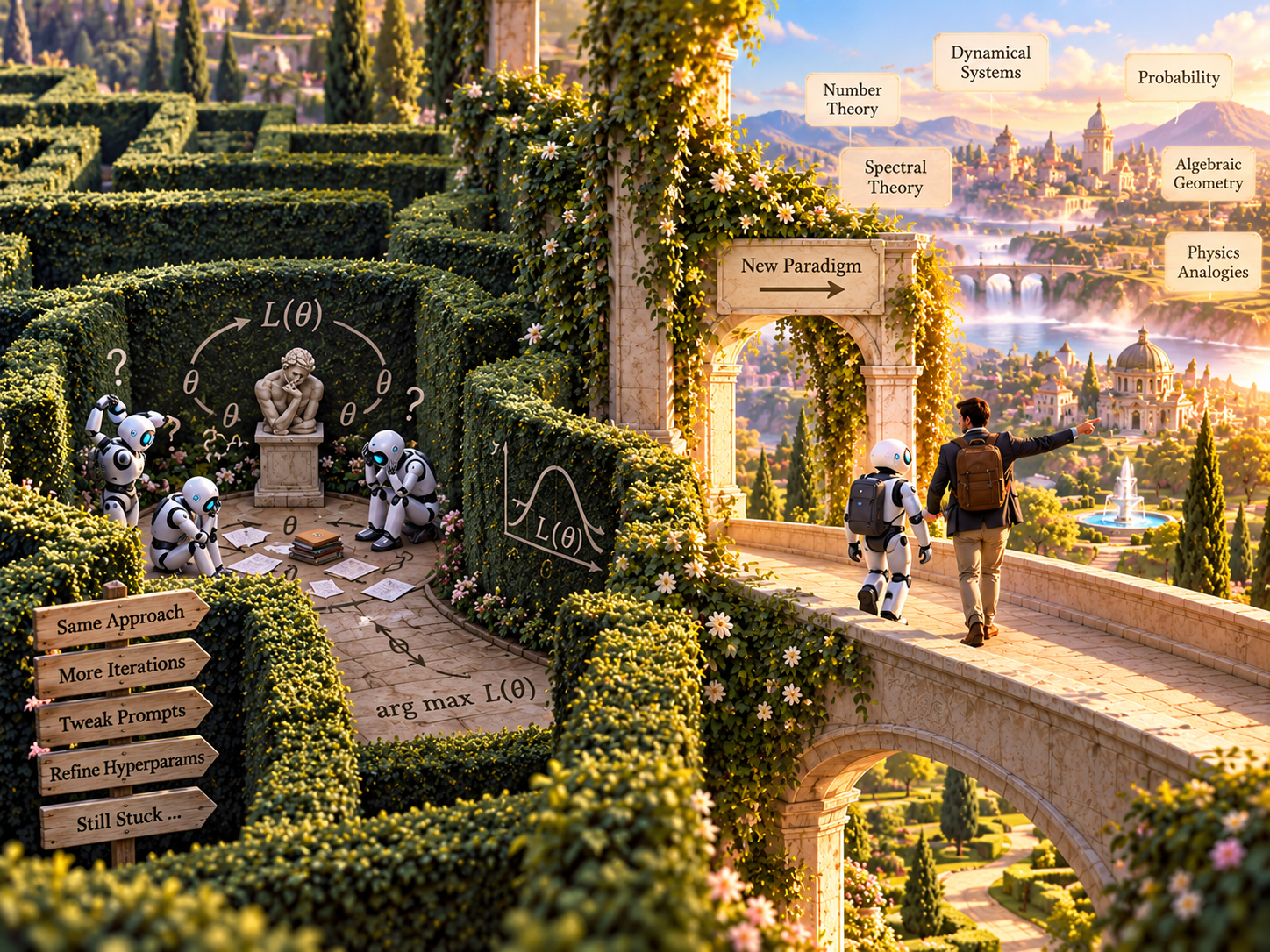
Yet long-horizon discovery sometimes demands a qualitatively different move: not another continuation, but a change in what counts as the relevant search space.
Once a framework accumulates equations, terminology, partial successes, citations, and internal momentum, it is natural to keep working inside that framework. Add another lemma. Try another variant. Increase the search. Add another agent. Tweak the prompt. Refine the hyperparameters. Run another verification script.
All of these can be rational locally while the global research direction is already exhausted.
I use the “maze” only as a metaphor for research path dependence, not as a technical claim about inference. Scientific discovery sometimes requires a move that does not naturally follow from the previous page: stop, set aside beautiful work, import a concept from another field, or ask a question that changes the geometry of the problem.
In the Collatz collaboration, several productive turns came after the problem was reframed or connected to a different mathematical viewpoint. Once a new direction was established, the LLMs could again move with extraordinary speed.
AI may raise the bar rather than remove the ladder
The usual labor-market question is: what jobs will AI take? That matters, but research presents another possibility.
Suppose a class of problems that once required three years of human effort can be explored in three months with AI. We do not automatically receive thirty-three months of intellectual unemployment. We may instead use the remaining time to attack a class of problems that was previously unreachable.
This is not guaranteed. Some tasks and careers will be displaced. Some institutions will capture more benefit than others. Access to frontier models and compute may create a new inequality between well-funded research centers and everyone else.
But it is a mistake to assume that the stock of difficult questions is fixed.
Science repeatedly produces deeper questions by answering earlier ones. A proof can expose a more general conjecture. A new microscope creates more biology, not less. A telescope that sees farther does not end astronomy. Better instruments often raise the level at which human judgment is needed.
AI may become such an instrument for thought.
If so, the scarce human contribution shifts upward:
The real crisis may be education, not employment
Our educational system was built around another scarcity assumption: students become capable by learning to produce artifacts that are difficult to produce.
Write the proof. Solve the problem set. Produce the program. Summarize the literature. Draft the essay. Pass the exam.
AI breaks the old coupling between producing the artifact and possessing the cognition that historically produced it.
A student can now submit a competent answer without building the internal model required to judge that answer. That does not mean we should ban AI. It means the object of education must change.
The question is no longer simply, “Can the student solve this?” It is:
- Can the student explain why the solution works?
- Can the student detect when the AI has proved a weaker statement than the one requested?
- Can the student reject an attractive but irrelevant direction?
- Can the student formulate a better question?
- Can the student connect two fields that the current prompt has kept separate?
- Can the student defend the core argument when the AI is turned off?
Deep fundamentals therefore become more important, not less. A person cannot supervise mathematics they do not understand. They cannot audit causal claims without causal literacy. And they cannot make good research judgments if every technical answer appears equally plausible.
Universities should adapt, but we may also need new learning centers
Universities remain essential. They preserve disciplinary depth, long-term mentorship, laboratories, intellectual communities, and forms of scholarship that should not be optimized only for commercial speed.
But universities are structurally slow. Degree requirements, semester schedules, departmental boundaries, curriculum committees, and assessment systems were built for a world in which the knowledge frontier moved more slowly than it does now.
That is why I think we should experiment with a new institutional layer: AI-era learning centers.
Not coding boot camps. Not model-training schools. Not places where students learn better prompts.
Something closer to a hybrid of a research institute, an apprenticeship, a liberal-arts seminar, and a cognitive gym.
| Traditional course model | AI-era learning center |
|---|---|
| Course-first | Problem-first: begin with an unresolved question worth pursuing. |
| Disciplinary sequence | Cross-domain learning: acquire mathematics, computing, science, policy, or ethics as the problem demands. |
| Teacher supplies the frame | Mentor challenges the frame: students must justify when to persist, stop, or reframe. |
| AI prohibited or hidden | AI-on / AI-off cycles: use every tool for frontier work, then remove the tool to test ownership of understanding. |
| Grade the final artifact | Audit the trajectory: what was tried, rejected, verified, reframed, and learned? |
| Known-answer assignments | Unknown-answer research: nobody, including the mentor, knows the final answer in advance. |
AI-on and AI-off should both be mandatory
When the goal is frontier exploration, students should have access to the strongest available AI. Artificially limiting tools would train them for yesterday's research environment.
But there should also be deliberate AI-off periods.
Without them, we cannot tell whether the student has built an internal representation or merely learned to operate an external cognitive service.
AI-on
Attack the frontier. Search broadly. Simulate. Code. Prove. Compare agents. Use machine scale aggressively.
AI-off
Explain the result. Reconstruct the key argument. Identify assumptions. Defend the judgment. Show what has become your own understanding.
The objective is not to catch cheating. It is to distinguish tool capability from human capability.
What should a student be evaluated on?
In an AI-era learning center, I would care less about whether the student produced the most polished artifact and more about questions such as these:
- What important question did you formulate that was not initially given to you?
- What did the AI suggest that you rejected, and why?
- Where did you detect a scope error, hidden assumption, or causal confusion?
- Which line of work did you stop because evidence showed it was exhausted?
- What useful connection did you import from another domain?
- What can you now explain without the model that you could not explain before?
- What uncertainty remains, and what evidence would change your mind?
Those are much closer to the abilities of a mature researcher than today's routine take-home assignments.
Human-centered AI should mean more than human customers
The phrase “human-centered AI” is now widely used. But it should carry a demanding standard.
A technology is not human-centered merely because humans use it, buy it, or invest in companies built around it. A genuinely human-centered AI agenda should ask whether rising machine capability also increases human capability, agency, access, judgment, and responsibility.
That standard matters because AI can produce two very different futures.
In one, a small number of institutions own the most capable systems, intellectual production becomes concentrated, students outsource increasingly large portions of cognition, and human expertise atrophies behind a polished interface.
In the other, AI lowers the cost of reaching the frontier, more people can participate in serious research, humans learn to supervise and challenge machines, and the frontier itself expands.
The technology alone will not choose between those futures. Institutions will.
When belief in AI becomes faith
There is also a cultural danger in assuming that future AI capability will clean up every present-day risk. Palantir CTO Shyam Sankar recently claimed that some AI researchers had begun smoking as a way of signaling confidence that AI would eventually cure cancer. Fortune reported the claim but noted that Sankar provided no evidence for how prevalent such behavior actually is.
The anecdote matters less as a statistic than as a warning. When expectations about future AI become strong enough to justify reckless choices today, technological optimism has started to behave like faith.
The frontier after the frontier
The OpenAI mathematics release is consequential because it makes a previously abstract question concrete. AI can now generate research artifacts at a volume that challenges the absorptive capacity of the scientific community.
That should not cause us to retreat from AI. Nor should we confuse volume with understanding.
My own experience with Collatz points to a more interesting possibility. AI can accelerate the exploration–verification–correction cycle dramatically. It can make one researcher feel like a small research group. But the value of that acceleration still depends on the quality of the questions, the structure of the collaboration, and the human capacity to understand what the system is producing.
The challenge is not to preserve today's intellectual difficulty so that humans still have something to do.
It is to prepare humans for a world in which AI continuously removes today's difficulty and exposes tomorrow's.
If AI raises the frontier, education must raise the human.
The greatest educational failure would be to use AI to make learning easier precisely when AI is making the intellectual frontier harder.
References & further reading
- OpenAI. “Sharing AI Progress in Mathematics.” October 6, 2026; updated October 15, 2026. OpenAI.
- OpenAI Developer Community. “First Look at Mathematics Manuscripts from an Internal Frontier Model at OpenAI.” October 6, 2026. The accompanying announcement reports 722 manuscripts in 372 related result families. Community post.
- Terence Tao. “Math 2.0.” October 10, 2026. What's new.
- Terence Tao. “The Future of Mathematics.” October 5, 2026. What's new.
- Edward Y. Chang. “Meta-Cognitive Judgment.” Chapter 11 in System-2 Reasoning: From Semantic Anchoring to Causal Intelligence, Vol. 2. ACM Books, 2026. ACM Books.
- Edward Y. Chang. “Exploring Collatz Dynamics with Human-LLM Collaboration.” arXiv:2603.11066v6, April 2026. arXiv.
- Marco Quiroz-Gutierrez. “Palantir's CTO Claims AI Researchers Are Smoking to Prove They Believe AI Will Cure Cancer.” Fortune, October 13, 2026. The article notes that the prevalence claim was not supported with evidence. Fortune.